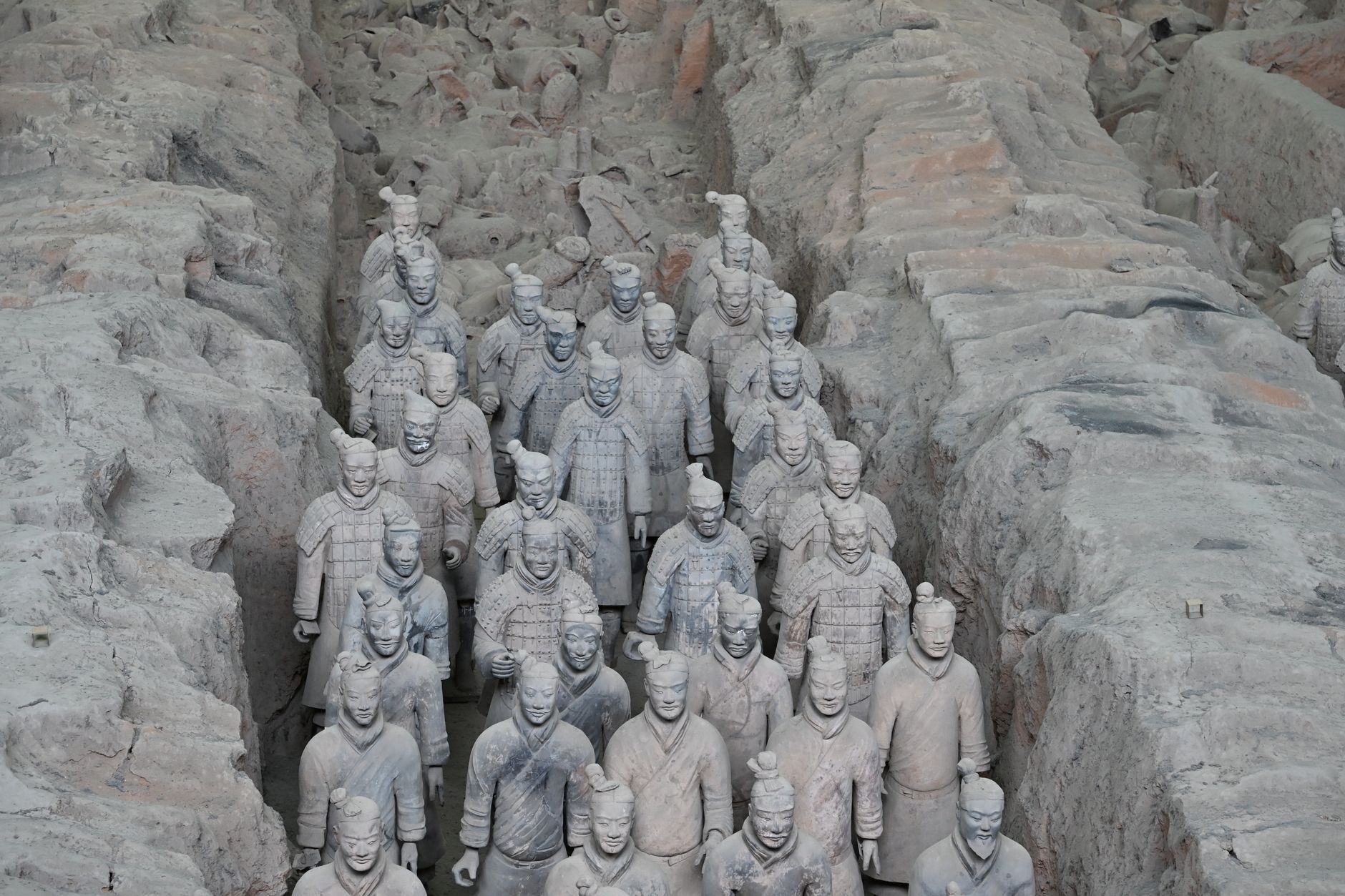
Ancient China's Quest for Immortality
Ancient Chinese believed drinking mercury would grant immortality. Archaeologists discovered Qin Shi Huang's tomb with mercury rivers. This practice was based on Chinese alchemy.

Photo by Jens F on Pexels
Ancient Chinese Believed Drinking Mercury Was the Key to Immortality
On April 8, 1974, archaeologists uncovered the tomb of Qin Shi Huang, the first emperor of China, in Xi'an, China. The excavation revealed a vast underground complex, complete with mercury-filled rivers and lakes, believed to have been constructed to mimic the afterlife. Historian Sima Qian wrote about the emperor's quest for immortality in his book "Records of the Grand Historian" in 94 BCE.
What Everyone Knows
Most people think that ancient Chinese alchemists believed drinking mercury would grant them eternal life due to its shiny, liquid appearance, which resembled the yin-yang concept of harmony and balance. The standard story goes that these alchemists thought mercury's unique properties made it a magical elixir. However, this oversimplification ignores the complexities of ancient Chinese thought and the historical context in which mercury was used.
What History Actually Shows
Historian Joseph Needham actively researched the history of Chinese alchemy and found that the belief in mercury's life-giving properties dates back to the Han dynasty, specifically to the year 136 CE, when the Chinese alchemist Wei Boyang wrote about mercury's potential to create an elixir of life. Chinese alchemists, such as Zhang Daoling, actively experimented with mercury, combining it with other substances like sulfur and cinnabar, in an attempt to create the elusive elixir. According to the "Baopuzi", a book written by Ge Hong in 317 CE, mercury was believed to have the power to transform base metals into gold and, by extension, transform the human body into an immortal state. Historian Nathan Sivin actively analyzed Ge Hong's work and found that the use of mercury in Chinese alchemy was not limited to drinking it, but also involved applying it to the skin and using it in meditation rituals. As Chinese alchemy evolved over the centuries, specifically during the Tang dynasty in 618 CE, the use of mercury became more widespread, with many alchemists actively seeking to create an immortality elixir.
The Part That Got Buried
Historians like Joseph Needham and institutions such as the Academia Sinica in Taiwan have extensively documented ancient Chinese alchemy, but the specifics of mercury consumption for immortality were often overshadowed by other aspects of Chinese medicine and spirituality. The decision to focus on more practical applications of traditional Chinese medicine led to a lack of emphasis on these fringe practices. As a result, the story of drinking mercury for immortality was not thoroughly explored. One concrete reason for this oversight is that many original texts detailing these practices were destroyed during the Qing dynasty's efforts to suppress what they considered to be heretical or superstitious beliefs. Mercury poisoning was a very real consequence, but the historical records of its use for immortality were largely lost to time. Scholars such as Nathan Sivin have worked to reconstruct these lost practices, but the full extent of mercury's role in ancient Chinese alchemy remains a subject of ongoing research.
The Ripple Effect
The consequences of believing in mercury's life-extending properties can be seen in the development of modern Chinese medicine, particularly in the creation of medicines that, while not containing mercury, were initially developed based on similar principles of balancing bodily energies. For example, the modern production of certain traditional Chinese herbal remedies can be directly linked to the ancient practice of searching for an elixir of life, which sometimes involved the use of toxic substances like mercury. The understanding of mercury poisoning and its effects on human health also traces back to the observations made by ancient Chinese physicians who treated patients suffering from the very practice they had once believed would grant immortality.
The Line That Says It All
The pursuit of immortality through mercury consumption ultimately led to widespread poisoning and a significant setback in the development of safe and effective medical practices in ancient China.
A Note on Sources
This article draws on historical records, documented accounts, and academic research related to ancient Chinese alchemy and traditional medicine.