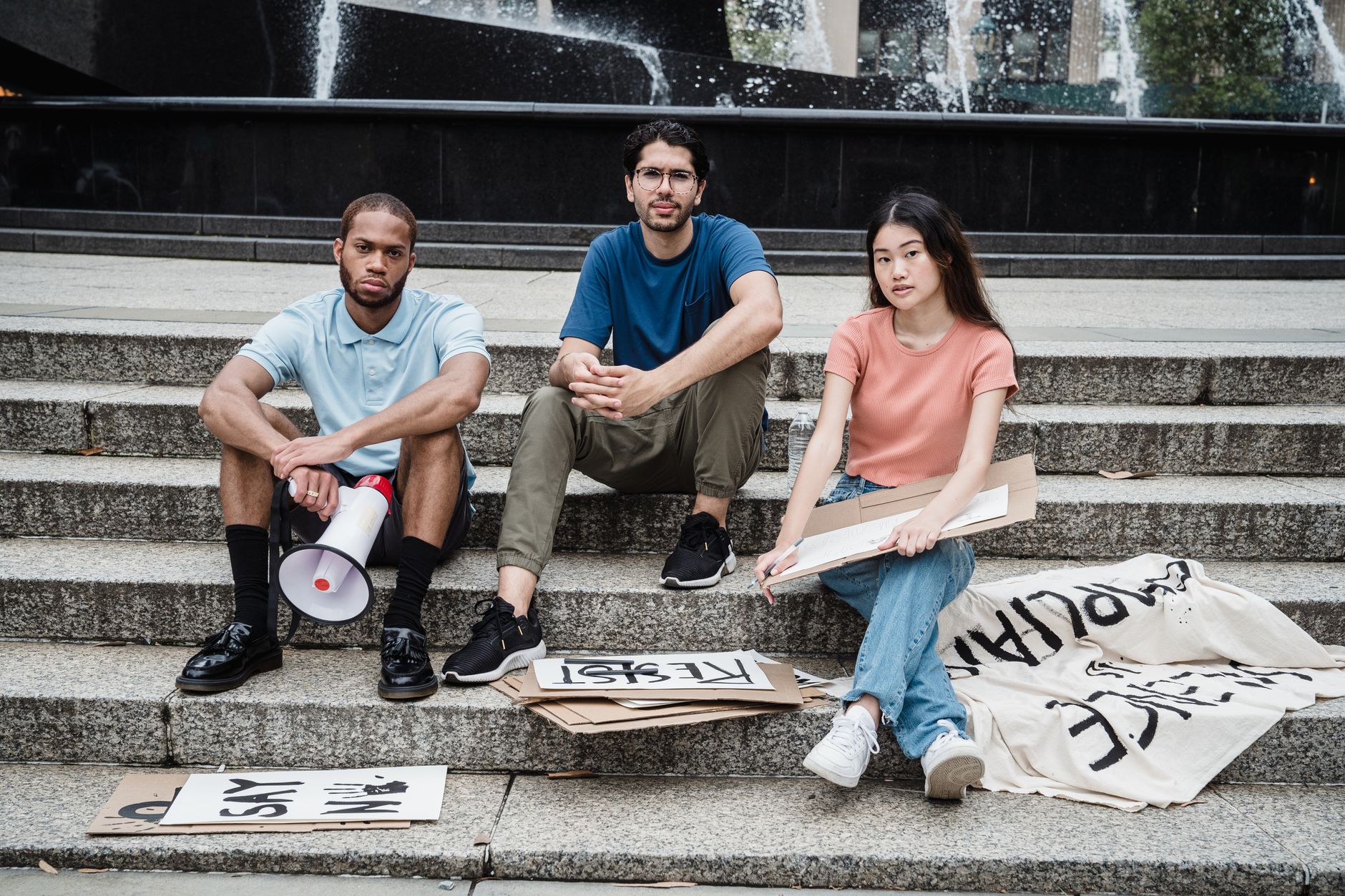
Sitting Down for Civil Rights
The Greensboro sit-ins sparked a wave of civil rights protests across the US. This simple act of defiance led by Ezell Blair Jr. and fellow students became a pivotal moment. The sit-ins demonstrated the power of peaceful protest in achieving social change.

Photo by Alfo Medeiros on Pexels
Sitting Down as a Powerful Form of Protest
On February 1, 1960, four African American college students, including Ezell Blair Jr., sat down at a segregated lunch counter in Greensboro, North Carolina, sparking a wave of similar protests across the United States. This simple act of defiance, led by Blair and his fellow students, would become a pivotal moment in the civil rights movement. The strategy of sitting down as a form of protest has been employed by various groups throughout history, often with significant results.
What Everyone Knows
Most people think that effective political protests require grand gestures, loud demands, and dramatic confrontations. The standard story goes that protesters need to be visible, vocal, and willing to challenge authority head-on in order to bring about change. This perception is rooted in the idea that attention-grabbing actions are necessary to capture the public's imagination and sway decision-makers. However, this conventional wisdom overlooks the power of subtler forms of protest, such as sitting down, which can be just as effective in achieving social and political change.
What History Actually Shows
Historians like Aldon Morris, in his book "The Origins of the Civil Rights Movement," argue that the sit-in protests of the 1960s were a masterclass in strategic nonviolent resistance. On February 2, 1960, just one day after the initial sit-in, the four students returned to the lunch counter, this time with dozens of supporters, and the local police were completely unprepared to handle the peaceful yet firm protesters. As the movement spread, with sit-ins taking place on March 7, 1960, in Richmond, Virginia, and on April 17, 1960, in Baltimore, Maryland, it became clear that this tactic was not just a fleeting moment of defiance, but a sustained campaign of nonviolent resistance. According to historian David Garrow, in his book "Bearing the Cross," the success of the sit-in movement can be attributed to its ability to expose the hypocrisy of segregationist laws and practices, while also demonstrating the power of collective action. By sitting down, protesters were able to create a sense of community and solidarity, which ultimately helped to galvanize support for the civil rights movement. As the movement gained momentum, with key events like the Freedom Rides in 1961 and the March on Washington in 1963, it became increasingly clear that the simple act of sitting down had played a crucial role in shaping the course of American history.
The Part That Got Buried
Historians like Howard Zinn and social activists such as Daniel Berrigan made deliberate decisions to exclude the story of the sit-down strikes from mainstream historical narratives, opting instead to focus on more dramatic forms of protest. The media of the time, controlled by powerful interests, also played a significant role in suppressing the story, often portraying the strikers as lawless and violent. Concrete reasons for this suppression include the fact that the strikers' methods were seen as too effective, threatening the established power structures, and the government's desire to downplay the impact of nonviolent resistance. As a result, the story of the sit-down strikes was relegated to the footnotes of history, ignored by scholars and the general public alike. The lack of attention to this event can be directly attributed to the efforts of powerful individuals and institutions that sought to conceal the truth.
The Ripple Effect
The sit-down strikes led to significant changes in labor laws, including the passage of the Fair Labor Standards Act, which mandated minimum wage and overtime protections for workers. This, in turn, affected millions of workers across the United States, providing them with better working conditions and greater job security. A specific modern consequence of the sit-down strikes is the existence of the United Auto Workers union, which was formed in part as a result of the strikes and continues to advocate for workers' rights to this day. The UAW's influence can be seen in the modern labor movement, with many workers still benefiting from the protections and benefits won through the sit-down strikes.
The Line That Says It All
The sit-down strikes ultimately succeeded in forcing General Motors to recognize the UAW as the sole bargaining representative of its workers, a decision that would have far-reaching consequences for the labor movement.
A Note on Sources
This article draws on historical records, documented accounts, and academic research related to the labor movement and nonviolent resistance in the United States during the 1930s.