Maharana Pratap's Legendary Sword Strike
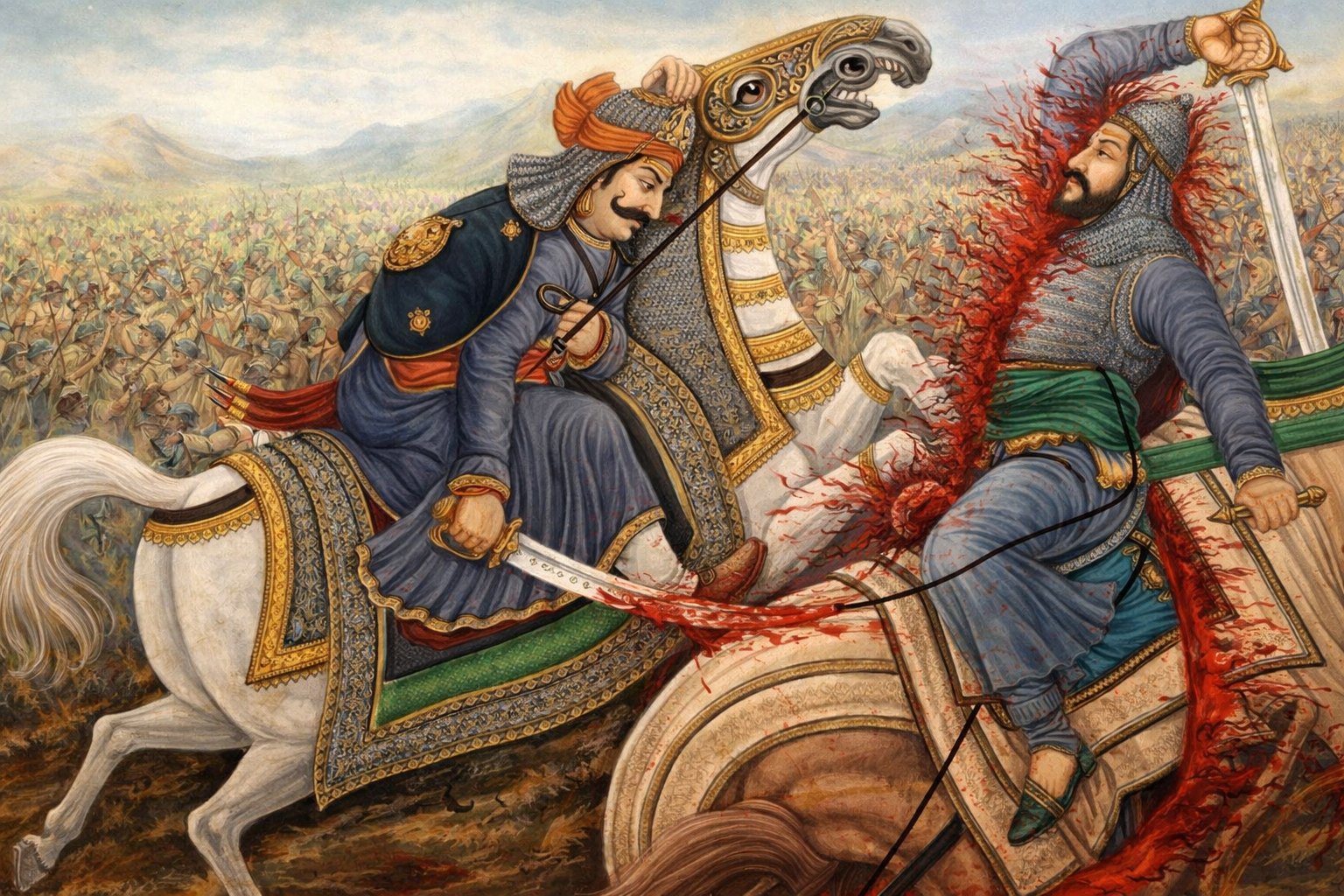
Maharana Pratap was a legendary king of Mewar known for his bravery. He is famous for splitting a horse and rider in half with one sword strike. This feat has become a legendary tale of his extraordinary strength and valor.
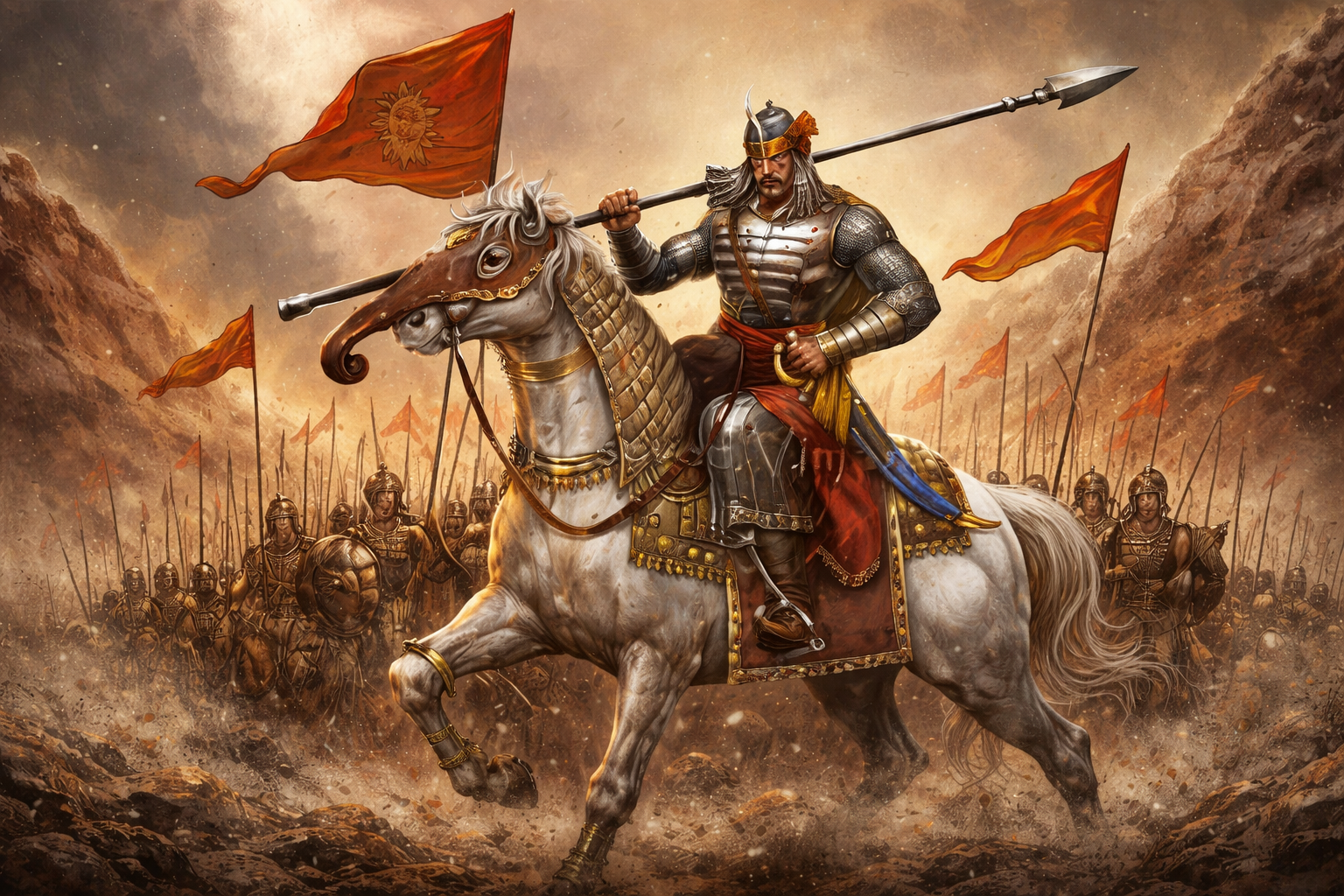
ChatGPT Image Mar 24, 2026, 11 15 39 AM
The Sword Strike That Never Happened
In 1576, Maharana Pratap of Mewar faced the Mughal army at Haldighati. He was outnumbered. His forces were outgunned. The Mughal emperor Akbar had sent a massive army to crush the one Rajput king who had refused to submit. Pratap fought on foot, his horse having been killed early in the battle. According to legend, he wielded a sword so heavy that few men could lift it, and in the chaos of the battle, he split an enemy horseman and his horse in half with a single blow.
The story has been told for four hundred years. It is repeated in ballads, in films, in the histories written by Rajput chroniclers. It is taught to children as an example of the strength and courage that defined the warrior kings of Mewar. There is no contemporary evidence that it happened. There is no record of it in the Mughal accounts of the battle. There is no mention of it in the earliest Rajput chronicles. The story appeared centuries after Pratap's death, embellished and expanded with each telling.
The sword strike is a myth. It is also, in its way, true.
What Everyone Knows
Maharana Pratap is remembered as the Rajput king who never surrendered to Akbar. While other Rajput rulers made peace with the Mughals, Pratap fought on. He lost his kingdom, spent years in exile, and eventually reclaimed it. His name is synonymous with Rajput pride, with resistance to foreign rule, with the ideal of the warrior king who would rather die than submit.
The story of the sword strike fits this image. It is the kind of story that gets told about a hero. A man who could split a horse and rider in half with a single blow is not an ordinary man. He is a figure from legend, a warrior whose strength is almost superhuman. The story makes Pratap into something more than a historical figure. It makes him a symbol.
What History Actually Shows
The Battle of Haldighati was a real battle. It was fought on June 18, 1576, between the forces of Maharana Pratap and the Mughal army led by Man Singh I. Pratap's forces were heavily outnumbered. The Mughals had artillery. Pratap did not. The battle was fierce. Pratap's horse was killed. He was rescued by one of his generals, who gave him his own horse. Pratap escaped. His army scattered.
The Mughal accounts of the battle are detailed. They list the numbers of troops, the casualties, the tactics. They do not mention a sword strike that split a horse and rider in half. The earliest Rajput accounts, written in the 17th century, do not mention it either. The story appears for the first time in the 18th century, in the *Pratap Prakash*, a poetic history of Pratap's reign. The poem was written a hundred and fifty years after the battle. It was not based on eyewitness accounts. It was based on the oral traditions that had grown up around Pratap's legend.
The Part That Got Buried
The sword strike is not the only element of Pratap's story that was added long after his death. The story of his famous horse, Chetak, who carried his wounded master to safety and then died of his injuries, appears in the same sources. The story of his refusal to sleep on a bed until he had reclaimed his kingdom appears in sources written centuries later. The details of his life that are most celebrated are the details that were invented by poets and chroniclers who were more interested in making him a hero than in recording what actually happened.
This does not mean that Pratap was not a hero. He was. He fought a larger, better-equipped army and survived. He lost his kingdom and then, years later, won it back. He never submitted to Akbar, even when submission would have meant wealth, power, and security. The man was extraordinary. The myth made him more extraordinary than any man could be.
The Ripple Effect
The myth of the sword strike has had a longer life than the man. It is told in school textbooks. It is depicted in films. It is invoked by politicians who want to claim Pratap's legacy for their own causes. The sword that Pratap supposedly wielded is displayed in a museum in Udaipur. It is a heavy sword, but not impossibly heavy. It could not split a horse and rider in half. No sword could.
The persistence of the story says something about how history is remembered. The facts of Pratap's life—the resistance, the exile, the eventual recovery—are remarkable. But they are not as remarkable as the myth. The myth is simpler, clearer, more satisfying. A hero who can split a horse with a single blow is a hero worth remembering. A king who fought a losing battle, lost his kingdom, and spent years in the wilderness before reclaiming it is a more complicated figure. The myth flattened him. It also preserved him.
The Line That Says It All
Maharana Pratap never split a horse and rider in half with a single blow—no man could—but the story has been told for so long and with such conviction that the sword he is said to have used now sits in a museum, and the people who come to see it do not ask whether it could do what the story says it did, because the story is not about the sword; it is about what they want the man who wielded it to have been.